The History of the Sea Kayak

From Inuit qajaqs through Dutch whalers to modern carbon kevlar - the materials, designs and traditions behind the modern expedition kayak.
The Inuit origin
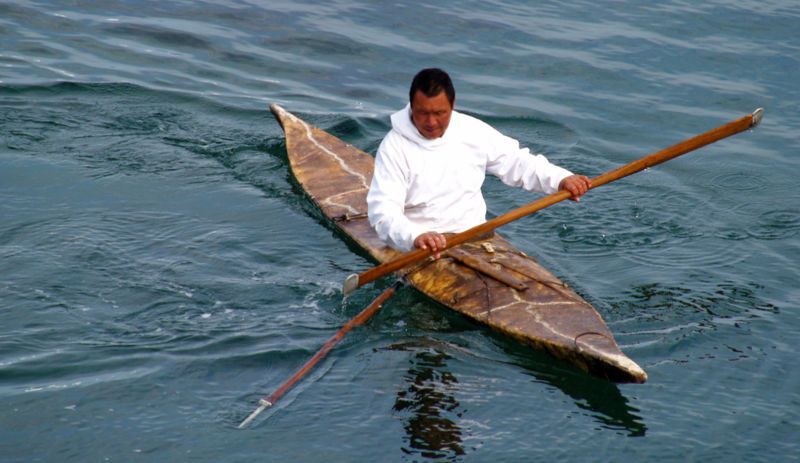
The qayaq or qajaq or kayak is the skin-covered sea-going craft used by the Eskimos of the Arctic - dating back to before AD500 with speculation that they were used as far back as 2000BC. Eskimo or Esquimaux was the name given to the Indians who occupied the Far North of the American continent by their southern neighbours. In fact there were several diverse Native peoples of the Arctic: the Inuit of Canada and Greenland, the Inupiat of Alaska, the Inuvialuit of the Mackenzie River delta and the Aleuts of Northern Siberia. Each used kayaks of specific design unique to their tribe.
Dutch whalers bring them back
Dutch whalers, plying the waters around Greenland in the 1600s brought kayaks back to Europe along with many other artefacts including hunting equipment, skins and ivory. Some of these kayaks still exist today in Dutch museums. These early kayaks were made of driftwood and bone, pegged and lashed together to make a light rigid frame, with the skins of five caribou or nine sealskins sewn on. Seal oil was used as waterproofing. These elegant craft were used to hunt walrus and seal. They were seaworthy, fast and silent; the perfect boat for a hunter.
The Inuit revival
The Inuit continued to build and use kayaks until the mid-nineteenth century, when cultural disruption and the availability of commercially made canoes and other boats took the place of traditional skin-covered kayaks. More recently the Inuit have attempted to revive their ancient culture. Qaanat Kattuffiat, the Greenland Kayak Association, is evidence of this. Those who remember the old ways have helped the new generations of Inuit preserve the traditional techniques of construction. Historians and scholars from both sides of the Atlantic have sought to preserve and record these skills.
The modern kayak
Most modern kayaks are produced in a mould, from plastic, or laminated in fibreglass and diolen and polyester resin or the more expensive hybrids of Kevlar and carbon fibre using vinylester or epoxy resins. Kayak manufacturers have tried to incorporate the lines of the Eskimo kayak into their modern designs. Many Inuit consider these new 'plastic' kayaks to be ugly and for the most part remain loyal to their traditionally built craft. Ugly or not, the modern sea kayak is incredibly seaworthy, and in the right hands is capable of undertaking long voyages in extreme conditions.
Derek Hutchinson's summation
Derek Hutchinson describes the potential of the sea kayak most eloquently in his book The Complete Book of Sea Kayaking: 'Sea kayaking gives a person the opportunity to venture on to a wild, unpredictable expanse in a craft that moves solely by the strength of their arm, directed by their experience and knowledge. Facing the challenge of the sea in this way causes a paddler to journey into the genuine unknown - the unknown and untried areas of his own soul. The sea kayaker depends on neither wind nor engine; he shares his craft and responsibility with no-one. The kayak man challenges the sea in what appears to be the most diminutive and delicate of crafts, even more fragile in appearance than the smallest of sailing dinghy. Nevertheless, the man who paddles the kayak well is the master of one of the finest, most seaworthy crafts in the world.'
Got something to add? Use the contact form - we update guides regularly based on reader experience.